

Tankless Water Heaters in Houston: Never Run Out of Hot Water Again
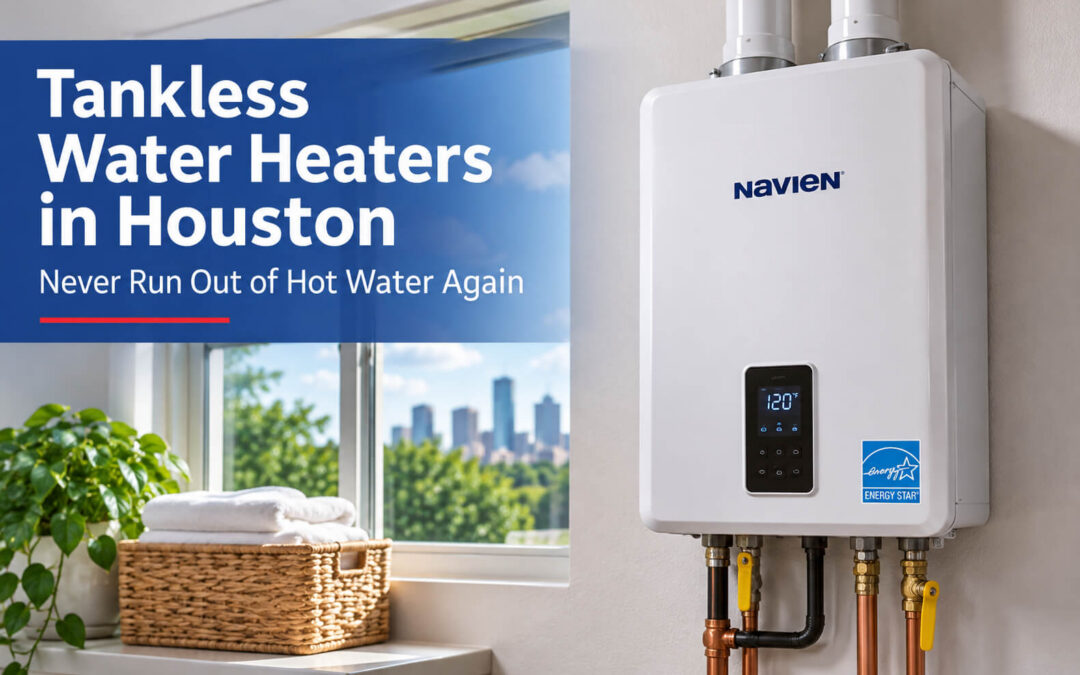
A Greater Houston guide to Navien tankless water heaters, costs, installation, and whether switching is worth it
Most households know the moment. Someone is halfway through a shower, the water starts to cool, and it never warms back up. The tank has run dry, and everyone after that waits for it to reheat.
A tankless water heater handles hot water differently. Instead of drawing from a large stored supply, it heats water as it flows through the unit. This guide covers how tankless works, what affects the cost and installation in Houston, where tankless has limits, and how to tell whether it is worth it for your home.
QUICK ANSWER
Are tankless water heaters worth it in Houston? For many homeowners, yes. A tankless water heater can be a good investment for a Houston household that often runs out of hot water, wants to free up space, or plans to stay in the home long-term. A gas tankless unit such as a Navien heats water on demand, so it provides continuous hot water as long as the household stays within the unit’s rated capacity. ENERGY STAR puts the life expectancy of a tankless water heater at 20 years, longer than conventional tank-type heaters. Proper sizing, installation, and annual maintenance are what make it perform well.
Table of Contents
- Why You Keep Running Out of Hot Water in the Shower
- How a Tankless Water Heater Works
- Tankless vs. Tank Water Heater: Side by Side
- How Much Does a Tankless Water Heater Cost in Houston?
- How Long Does Tankless Water Heater Installation Take?
- Endless Hot Water, With One Real Limit
- Space, Lifespan, and Efficiency
- Why Navien Tankless Water Heaters
- Condensing vs. Non-Condensing Tankless
- What Houston Homeowners Should Know Before Switching to Tankless
- Is a Tankless Water Heater Worth It in Houston?
- Why Professional Installation Matters
- Frequently Asked Questions
- Get a Free Tankless Water Heater Quote
QUALITY TIP: PLAN THE SWITCH BEFORE THE TANK FAILS
When a tank fails without warning, most families replace it with the same thing just to get hot water back. Looking at tankless while the old tank still works leaves time to check the gas line and venting, and to choose the right unit.
Why You Keep Running Out of Hot Water in the Shower
If you keep running out of hot water in the shower, the cause is usually simple: the tank is empty. A tank water heater holds a fixed amount of water and keeps it hot around the clock. Every shower, load of laundry, and dishwasher cycle draws from that same supply. Once it is used up, cold water refills the tank and has to be heated from scratch. That wait is called recovery time.
Winter makes it worse. The water coming into the house is colder, so every gallon takes more energy to heat. The tank drains faster and takes longer to recover. A water heater that kept up in July can leave the family short in January.
An aging tank adds to the problem. Sediment and scale build up at the bottom over the years, take up space, and make the burner or element less effective.WHY THE SAME SHOWER USES MORE HOT WATER IN WINTER
When the incoming water is colder, the shower valve mixes in more hot water to reach the same comfortable temperature. The household uses more hot water for the same shower, which empties a tank sooner.
How a Tankless Water Heater Works
A tankless water heater, also called an on-demand water heater, heats water as it is used. When a faucet or shower opens, a flow sensor detects the water moving through the unit. A gas burner fires, and a heat exchanger warms the water as it passes through. When the tap closes, the burner shuts off.
Unlike a conventional storage water heater, a tankless system does not rely on a large stored supply, so it does not run dry the way a tank does. ENERGY STAR describes gas tankless water heaters as providing “an endless flow of hot water.”
A tankless unit also avoids keeping a full tank of water hot around the clock. Its controls do use a small amount of electricity, and recirculation features, where they are used, use additional energy.
Tankless vs. Tank Water Heater: Side by Side
The table below compares a conventional storage tank with a tankless water heater. Quality Home Products of Texas installs both, and you can compare tank and tankless water heater options on its website.
| Consideration | Tank Water Heater | Tankless Water Heater | What It Means at Home |
| Hot water supply | Limited to what the tank holds | Continuous while demand stays within the unit’s rated flow | No waiting for a tank to reheat between showers |
| How it heats | Keeps a full tank hot around the clock | Heats water as it flows through the unit | No energy spent keeping a full tank hot |
| Size | Large floor-standing tank | Compact, wall-mounted unit | Frees up space in a garage, closet, or utility room |
| Life expectancy | Shorter than tankless | About 20 years, per ENERGY STAR | Fewer replacements over the life of the home |
| Leak risk | A tank can rust through and flood the area around it | No large storage tank to fail | Less risk of water damage from a burst tank |
| Upfront investment | Lower | Higher, especially when converting from a tank | Value comes over time from lifespan, space, and comfort |
Source note: General comparison only. Performance depends on the specific model, the size of the unit, household demand, incoming water temperature, and installation.
How Much Does a Tankless Water Heater Cost in Houston?
The cost of a tankless water heater in Houston depends on much more than the unit itself. Two homes can install the same Navien model and end up with very different projects. The main factors are:
- The size and model of the unit, which depend on how much hot water the household uses at once
- Whether the existing gas line and meter can supply what a tankless unit needs, or need to be upgraded
- Venting, including where the vent has to run and what material the unit calls for
- Where the unit will be installed, such as a garage, closet, attic, or exterior wall
- Condensate drainage for condensing units, and an electrical outlet for the unit’s controls
- Removing and disposing of the old tank, plus any permits the city requires
Replacing an old tankless unit with a new one is usually the simplest job. Converting from a tank often involves new gas, venting, and plumbing work, which adds to the upfront cost. A tankless water heater generally costs more up front than a like-for-like tank replacement, and its value comes over time from its longer life, smaller footprint, and continuous hot water.
The most reliable way to get an accurate number for your home is to request a free quote from Quality Home Products of Texas. Quality also offers financing options with approved credit.
How Long Does Tankless Water Heater Installation Take?
Installation time depends mostly on whether the home already has a tankless unit.
Replacing an existing tankless water heater with a new one is usually the fastest job, because the gas line, venting, and connections are already in place. Converting from a tank to tankless takes longer, because the installer may need to upsize the gas line, run new venting, add a condensate drain, and mount the unit on the wall. Some cities also require a permit and an inspection, which can affect scheduling.
Your installer can give you a realistic timeline after seeing the home and confirming what the project involves.
Endless Hot Water, With One Real Limit
Tankless does not mean unlimited in every situation. A tankless unit heats a certain number of gallons per minute. If the household asks for more than that at one time, the water at each fixture can lose temperature. Colder incoming water in winter also lowers how many gallons per minute a unit can deliver at full temperature.
That is why sizing starts with two questions: how many fixtures does the home run at once during its busiest hour, and how cold does the incoming water get in winter? A family that runs two showers, the dishwasher, and the washing machine at the same time needs more capacity than a couple who rarely runs more than one fixture.
Larger homes have options. Navien units can be linked so two or more work as one system, and the Navien NPE-A2 can cascade up to 32 units with Navien’s Ready-Link technology.
NOT SURE WHAT SIZE TANKLESS WATER HEATER YOUR HOME NEEDS?
Every household uses hot water differently. Quality Home Products of Texas can help you find out whether a Navien tankless water heater is the right fit for your home. Request a free quote today.
Space, Lifespan, and Efficiency
Space. A tankless unit mounts on the wall. ENERGY STAR says a gas tankless water heater saves “an extra closet’s worth of space” compared with a gas storage tank. On its Navien page, Quality Home Products of Texas notes that a condensing tankless unit is about 70 to 80 percent smaller than a tank system.
Lifespan. ENERGY STAR puts the life expectancy of a tankless water heater at 20 years, much longer than any conventional tank-type water heater. With no large storage tank, the risk of a tank leak and the water damage that comes with it goes away.
Efficiency. ENERGY STAR describes tankless units as heating water “only when you need it,” instead of keeping a full tank hot all day and night. High-efficiency condensing models such as the Navien NPE-A2 go a step further by capturing heat that would otherwise go out the vent.
Why Navien Tankless Water Heaters
Quality Home Products of Texas installs Navien tankless water heaters across Greater Houston. Navien’s NPE-A2 series includes several features that address common complaints about tankless units in general.
ComfortFlow built-in recirculation. Navien describes ComfortFlow as a system that “incorporates a buffer tank and recirculation pump.” The buffer tank helps reduce the “cold water sandwich,” a short burst of cold water some tankless units produce when a tap is turned off and back on. The built-in pump can also recirculate water so hot water reaches the fixture faster.
High efficiency. The NPE-A2 is a condensing unit rated at up to 0.95 UEF (Uniform Energy Factor), with dual stainless steel heat exchangers.
Easy controls. The control panel shows the water temperature and flow rate and runs self-diagnostics. Navien’s optional NaviLink Wi-Fi system lets homeowners check on the unit from anywhere with internet service.
Warranty. Navien’s published residential warranty for the NPE-A2 covers the heat exchanger for 15 years, parts for 5 years, and labor for 1 year when recirculation is standard or controlled. If an external pump circulates water through the unit continuously, the terms drop to 5 years on the heat exchanger and 3 years on parts. Navien’s warranty also requires a licensed installer, installation that follows the manual, and regular maintenance.
WHAT IS THE “COLD WATER SANDWICH”?
With some tankless units, turning a shower off and quickly back on sends a short slug of cold water through the line before hot water returns. Navien’s ComfortFlow buffer tank is designed to reduce that effect.
Condensing vs. Non-Condensing Tankless
Tankless water heaters come in two main types. A condensing unit captures extra heat from its exhaust before it leaves the vent, which makes it more efficient. A non-condensing unit is simpler but sends more heat out the vent.
| Consideration | Condensing Tankless | Non-Condensing Tankless |
| Efficiency | Ultra-high efficiency, UEF up to 0.96 | High efficiency, UEF above 0.80 |
| Venting | Often PVC; the NPE-A2 allows 2″ PVC | Usually requires metal or other heat-rated venting; varies by model |
| Long-term operating cost | Lower than non-condensing and storage tank systems | Can be higher than condensing, lower than a storage tank |
| Maintenance | Annual service recommended | Routine maintenance required; frequency depends on water quality, usage, and the manufacturer |
| Size | About 70 to 80 percent smaller than a tank system | About 80 percent smaller than a tank system |
Source note: Based on the Navien tankless water heater page on qualitytx.com and Navien’s NPE-A2 specifications. Venting and maintenance requirements vary by model, so the installation manual for the specific unit always applies.
What Houston Homeowners Should Know Before Switching to Tankless
Most tankless guides are written for the whole country. These are the issues that matter most in Greater Houston.
Hard Water and Mineral BuildupHard water is common across much of Texas. The calcium and magnesium in hard water leave scale inside a tankless unit’s heat exchanger, which makes it work harder over time. Navien’s warranty excludes damage caused by hard water deposits and mineral buildup, so scale is worth taking seriously. Read more in the guide to hard water problems in Texas.
Many homeowners pair a tankless unit with a RainSoft water conditioner to reduce the hardness that causes scale. Water treatment helps, but it does not replace the annual maintenance and flushing a tankless unit needs.
Colder Incoming Water in WinterHouston winters are mild compared with much of the country, but incoming water still gets noticeably colder during the winter months. A unit sized only for summer conditions can fall short on the coldest mornings. Sizing for winter keeps it ahead all year.
Freezes and Power OutagesA gas tankless water heater still needs electricity to run its controls, ignition, and fan, so it will not make hot water during a power outage. Navien states that its units have a freeze protection function that requires electricity, and that if power is lost during a freeze, that protection stops working. For homes prone to outages, Navien recommends a battery backup or generator when freezing weather is predicted.
Built-in freeze protection protects the unit itself, not the water and gas lines running to it. Navien recommends insulating the pipes connected to the water heater, and units in garages or outdoors are at the highest risk.
Quality Home Products of Texas offers both home standby generators and Bronco Power Boost battery backup systems.
KEEP THE UNIT PLUGGED IN DURING COLD WEATHER
Navien’s instructions are to leave the power cord connected and the gas valve open except for routine maintenance, because its freeze protection depends on both. If power or gas has to be off for an extended period in freezing weather, Navien says to drain the unit.
A gas tankless unit uses much more gas per hour while it is running than a typical tank, so the existing gas line and meter have to be checked before installation. The line that fed an old tank is often too small for a tankless unit and may need to be upgraded. Venting has to be planned for the specific model and location as well.
Is a Tankless Water Heater Worth It in Houston?
A tankless water heater costs more up front than replacing a tank with another tank. Whether it is worth it depends on the household. Tankless tends to make the most sense when:
- The household regularly runs out of hot water, especially during morning showers or when guests are staying
- The current tank is 10 or more years old, showing rust, or starting to leak
- The family has grown, or a bathroom has been added since the water heater was installed
- The homeowner wants to free up space in a garage, closet, or utility room
- The homeowner plans to stay in the home long enough to benefit from a 20-year life expectancy
Tankless also asks for a little more care. A condensing unit should be serviced once a year, and homes with hard water should plan for periodic flushing.
Keeping a tank can make more sense when the current water heater is newer and working well, the household rarely runs short, or the homeowner plans to sell soon. A free quote from Quality Home Products of Texas can help you compare both options.
Why Professional Installation Matters
A tankless water heater has to be matched to the home. The installer sizes the unit for peak demand and winter water temperatures, confirms the gas supply, plans the venting, and handles condensate drainage on condensing models. A unit that is undersized, or installed on a gas line that cannot keep up, can disappoint even when tankless was the right choice.
Installation also affects the warranty. Navien’s warranty is void if the unit was bought online or from a source Navien has not authorized, installed by a non-licensed installer, or installed without following the manual.
Quality Home Products of Texas has served Greater Houston since 1989 and installs tank and tankless water heaters from Navien and Bradford White, along with RainSoft water conditioners and home standby generators. Contact Quality Home Products of Texas for a free quote.
Frequently Asked Questions
How much does it cost to install a tankless water heater in Houston?
It depends on the size of the unit, whether the gas line needs to be upgraded, venting, where the unit will be installed, and whether the project replaces a tank or an existing tankless unit. A free quote from Quality Home Products of Texas is the most reliable way to get an accurate number for a specific home. Quality also offers financing with approved credit.
Is a tankless water heater worth it?
For households that often run out of hot water, want to save space, or plan to stay in the home long-term, tankless is often worth the higher upfront investment. If the current tank is newer and keeping up, or the home will be sold soon, keeping the tank may make more sense.
Can I replace my 50-gallon water heater with a tankless system?
In most homes, yes. The conversion usually involves checking or upgrading the gas line, adding new venting, and mounting the unit on a wall. A properly sized tankless unit can replace a 50-gallon tank without the household running out of hot water.
How long does tankless water heater installation take?
Replacing an existing tankless unit is usually the fastest job. Converting from a tank takes longer because it can involve gas line, venting, and drainage work, and some cities require a permit and inspection. Your installer can give you a timeline after seeing the home.
Will a tankless water heater really never run out of hot water?
A tankless unit does not run dry the way a tank does, because it heats water as it flows. It can fall behind if the household demands more hot water at one time than the unit is rated for. Proper sizing prevents that.
Does a tankless water heater work during a power outage?
No. A gas tankless water heater needs electricity to run its controls, ignition, and fan. Navien recommends a battery backup or generator for homes prone to outages when freezing weather is expected.
Do tankless water heaters need maintenance?
Yes. Condensing units such as the Navien NPE-A2 should be serviced once a year. In hard water areas, periodic flushing removes scale from the heat exchanger, and a water conditioner can slow how quickly scale builds up.
Does a tankless water heater increase home value?
It can be an appealing feature for some buyers, especially because of the space savings and continuous hot water. How much it affects resale value depends on the home and the local market, so it is best treated as a comfort and efficiency upgrade rather than a guaranteed return.
Get a Free Tankless Water Heater Quote
If the last shower in your house keeps going cold, or your tank is getting older, now is a good time to look at tankless, before the coldest weeks of the year.
Quality Home Products of Texas installs Navien tankless water heaters across Greater Houston. Contact Quality Home Products of Texas for a free quote. Financing is available with approved credit.
Sources
Quality Home Products of Texas – Navien Tankless Water Heaters
Quality Home Products of Texas – Tankless/Water Heaters
Quality Home Products of Texas – Financing
Navien – How to Avoid (or Thaw) a Frozen Tankless Water Heater
ENERGY STAR – Save More with ENERGY STAR Gas Tankless Water Heaters
READY FOR HOT WATER THAT KEEPS UP?
Contact Quality Home Products of Texas for a free quote on a Navien tankless water heater for your Greater Houston home.